AI Marketing Agent Insights for Modern Growth Teams
MeetLyra Journal covers AI marketing agents, SEO automation, content systems, and the shift from manual marketing execution to autonomous workflows.
MeetLyra Journal covers AI marketing agents, SEO automation, content systems, and the shift from manual marketing execution to autonomous workflows.


Discover how AI campaign planning can transform your marketing workflow. This guide for founders and lean teams covers the core components,.
AI campaign planning is the use of artificial intelligence to research, strategize, create, and execute marketing campaigns. Instead of relying on manual data analysis, spreadsheets, and guesswork, AI systems analyze vast datasets to build comprehensive, data-driven campaign plans in a fraction of the time.
For startup founders and lean marketing teams, this isn’t just an incremental improvement; it’s a fundamental shift. It allows you to compete with larger, better-funded teams by automating the most time-consuming parts of marketing, from audience research to content creation and performance analysis.
This guide breaks down how AI campaign planning works, the core components you can automate, and how to implement it in your business. We’ll also explore the shift from using fragmented AI tools to deploying single, autonomous marketing agents that can manage the entire process for you.
Traditional campaign planning is a labor-intensive process. It involves weeks of market research, competitor analysis, brainstorming sessions, and manually building out content calendars and ad schedules in spreadsheets. The final plan is often a static document based on a limited set of data and a lot of intuition.
AI campaign planning transforms this workflow. It leverages machine learning models to analyze real-time data from thousands of sources—competitor websites, social media trends, SERP data, and your own customer analytics—to generate a dynamic, optimized strategy.
The primary benefits for a lean startup are clear:
| Aspect | Traditional Campaign Planning | AI Campaign Planning |
|---|---|---|
| Research | Manual, slow, limited data sources (e.g., surveys, focus groups, manual competitor checks). | Automated, real-time analysis of massive datasets (SERPs, social media, customer data). |
| Strategy | Based on historical performance and team intuition. Often static. | Predictive and dynamic. Adjusts based on real-time market signals and performance data. |
| Content Creation | Entirely manual. Slow and resource-intensive. | AI-assisted or fully automated for copy, images, and video, enabling rapid A/B testing. |
| Execution | Manual scheduling and posting across channels. | Automated scheduling, channel selection, and budget allocation based on performance predictions. |
| Optimization | Reactive. Manual analysis of reports after the campaign runs. | Proactive and real-time. AI provides continuous optimization recommendations. |
This workflow follows Google Search Central guidance: useful, original, people-first content matters more than whether AI helped create the first draft.
An effective AI campaign planning system doesn’t just write ad copy. It orchestrates the entire marketing lifecycle. Here are the key components that AI can manage.
ai campaign planning works best when it turns strategy into a repeatable publishing system, not just another drafting shortcut.
SEO Machine quality gate
Before you can create a campaign, you need to know who you’re talking to and what the competitive landscape looks like. AI excels at this initial research phase.
AI platforms can synthesize data from your CRM, Google Analytics, and public sources like social media and forums to build incredibly detailed customer personas. They identify pain points, buying triggers, and the channels where your audience spends their time. This goes far beyond basic demographics, giving you a deep psychographic understanding of your ideal customer.
Instead of setting arbitrary goals, AI can analyze your historical performance and industry benchmarks to recommend achievable targets. For example, it might suggest a goal of “Increase qualified leads from organic search by 20% in Q2” and identify the key performance indicators (KPIs) needed to track it, such as keyword rankings, click-through rates (CTR), and conversion rates.
| Workflow | Manual SEO | Agentic SEO |
|---|---|---|
| Research | Spreadsheet-led and slow | Scored opportunities |
| Drafting | One-off briefs | Context-aware generation |
| Optimization | Manual plugin checks | Pre-publish quality gate |
This is where generative AI shines. Based on the audience research and strategic goals, an AI system can generate a complete content plan. This includes:
This level of automation allows you to produce a high volume of diverse content, which is critical for testing and finding what resonates with your audience. For more on this, see our guide to the best AI content automation tools.
Which channels will give you the best return on investment? AI-powered predictive models can analyze your past performance and market data to recommend an optimal channel mix. It can suggest how to allocate your budget across SEO, PPC, social media, and email marketing to maximize your primary KPI, whether it’s leads, sales, or brand awareness.
It automates opportunity research, content creation, on-page optimization, publishing preparation, and monitoring.
No. It handles repeatable execution so humans can focus on positioning, evidence, and quality control.
Once the plan is approved, AI can handle the execution. This includes scheduling social media posts for optimal engagement times, launching ad campaigns, and deploying email sequences. This automation eliminates the manual, error-prone work of managing multiple platforms and schedules.
A campaign plan shouldn’t be static. AI systems monitor performance in real-time, 24/7. They can identify underperforming ads or content and automatically pause them, reallocating budget to the top performers. They can also provide plain-language insights and recommendations, such as “The headline ‘Save Time on Marketing’ is performing 35% better than ‘Automate Your Workflow.’ Consider using it in your landing page copy.”
Adopting AI for campaign planning doesn’t have to be an all-or-nothing proposition. You can start small and scale your efforts. Here’s a practical framework.
Before you even look at a tool, be crystal clear about your primary business objective. Is it generating more trial signups? Increasing monthly recurring revenue (MRR)? Reducing customer churn? AI needs a single, clear goal to optimize for. Without a well-defined North Star, the AI will be flying blind.
The quality of your AI’s output depends entirely on the quality of its input. Ensure your core data sources—Google Analytics, CRM, ad platforms, email service provider—are clean, organized, and accessible. The more high-quality historical data you can feed the AI, the more accurate its predictions and recommendations will be.
You have two main approaches to building your AI marketing stack:
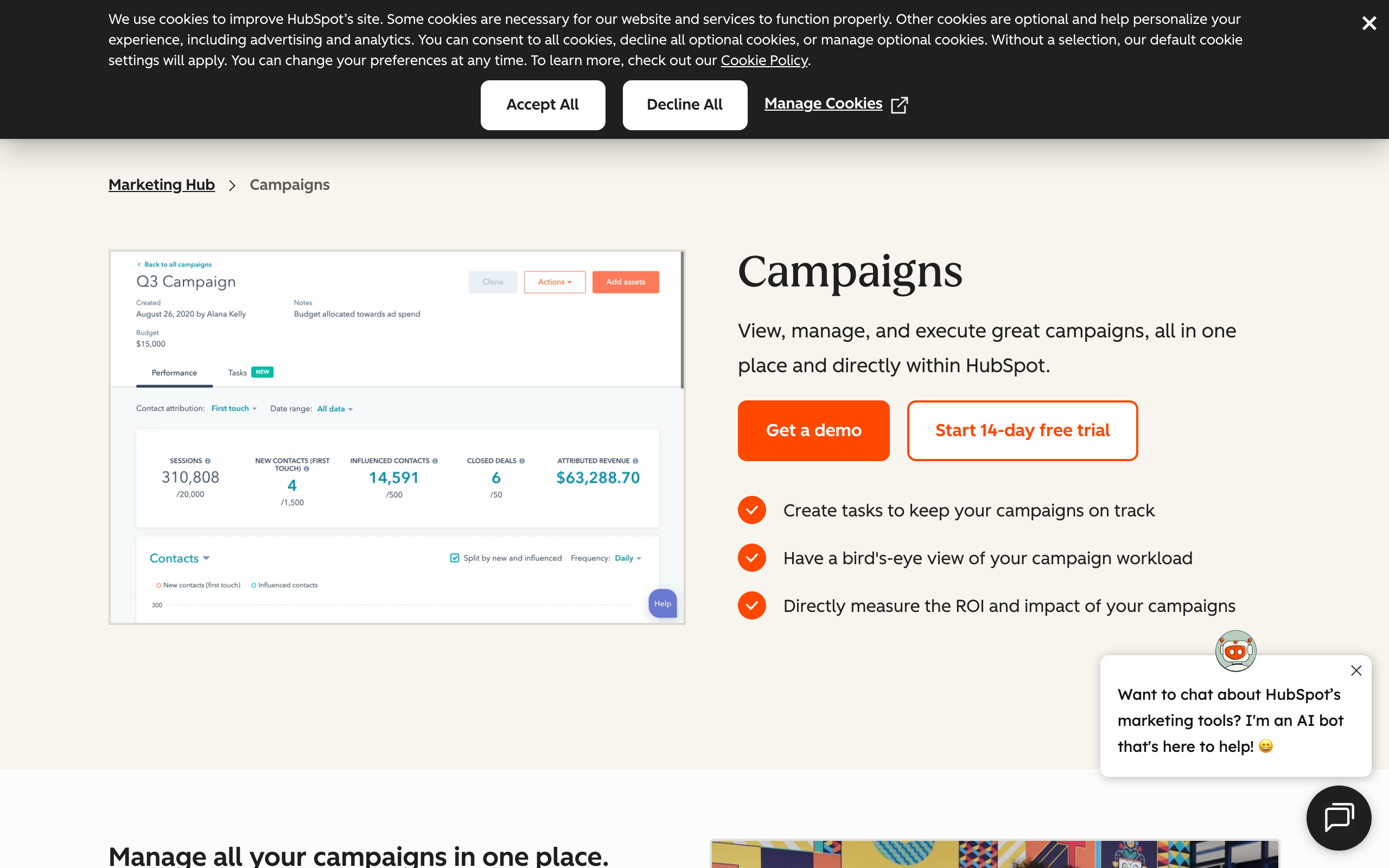
Don’t try to automate your entire marketing department overnight. Pick a single, well-defined project for your first AI-powered campaign. A new feature launch, a webinar promotion, or a targeted lead generation campaign are all great candidates. This allows you to test the process, learn the capabilities of your AI system, and build trust in its outputs.
AI is a powerful co-pilot, not a replacement for human expertise and oversight. Your role shifts from a manual doer to a strategic reviewer. The AI generates the plan and the assets, but you provide the final approval. You ensure the brand voice is correct, the strategic direction is sound, and the creative is compelling. This HITL model combines the speed and data-processing power of AI with the intuition and strategic wisdom of an experienced marketer.
For the last few years, the conversation around AI in marketing has been about individual tools. A tool to write blog posts. A tool to make images. A tool to analyze data. While useful, this creates what we call “AI chaos”—a messy, expensive, and inefficient collection of single-purpose applications that don’t talk to each other.
The future of AI campaign planning lies in consolidation and autonomy. The market is moving toward integrated platforms and true AI marketing agents.
An autonomous agent is a system that can understand a high-level objective and then independently execute the steps required to achieve it. You don’t tell it *how* to do the research or *what* to write. You give it the goal—for example, “Generate 100 qualified leads for our new SaaS product in the next 30 days”—and it formulates and executes the entire campaign plan.
This is a paradigm shift in AI campaign management. It moves the founder or marketer from being a tool operator to a true strategist, overseeing a system that handles the tactical execution.
While the potential is enormous, it’s important to be aware of the challenges and limitations.
The goal is to find the right balance, using AI to handle 80% of the tactical work so your team can focus on the 20% that requires human creativity, empathy, and strategic insight.
The era of manual, spreadsheet-driven marketing is over. AI campaign planning is now an accessible and essential capability for any startup that wants to grow efficiently. By moving from fragmented tools to integrated, autonomous agents, you can put your marketing strategy, content creation, and execution on autopilot.
Ready to see how an autonomous marketing agent can build and run your campaigns? Join the private beta waitlist for MeetLyra to get early access and learn how to automate your entire marketing workflow.
An AI campaign is a marketing initiative where key elements—such as audience research, strategy, content creation, media buying, and performance optimization—are planned and executed using artificial intelligence technologies. The goal is to create more effective, data-driven campaigns with greater speed and efficiency than manual methods.
AI helps in marketing campaigns by automating complex and time-consuming tasks. It can analyze massive datasets to uncover audience insights, predict which strategies will perform best, generate personalized content (text, images, video) at scale, automate ad buying and budget allocation, and provide real-time optimization recommendations to improve ROI.
Currently, AI is best viewed as a powerful co-pilot for a marketing strategist, not a replacement. AI excels at data analysis, pattern recognition, and automating tactical execution. However, it still requires human oversight for high-level strategic direction, brand guardianship, creative intuition, and ethical considerations. The strategist’s role evolves from ‘doing’ to ‘directing and reviewing’.
The best AI tools for campaign planning are shifting from single-point solutions (like a tool just for copywriting or just for analytics) to integrated platforms or autonomous agents. Systems like MeetLyra aim to provide an end-to-end solution that handles everything from market research and strategy to content creation and execution within a single, unified system.