AI Marketing Agent Insights for Modern Growth Teams
MeetLyra Journal covers AI marketing agents, SEO automation, content systems, and the shift from manual marketing execution to autonomous workflows.
MeetLyra Journal covers AI marketing agents, SEO automation, content systems, and the shift from manual marketing execution to autonomous workflows.
pThe best AI marketing agent isn't just another AI writer or social media scheduler; it's an autonomous system that connects.
The best AI marketing agent isn’t just another AI writer or social media scheduler; it’s an autonomous system that connects high-level business goals directly to marketing execution. While many tools claim to be ‘agents,’ most are single-function applications that still require significant human oversight. A true AI marketing agent acts as a strategic partner, capable of planning, creating, and deploying multi-channel campaigns to achieve objectives like lead generation or revenue growth with minimal intervention.
For founders and lean marketing teams, the distinction is critical. The goal isn’t to manage more software; it’s to automate outcomes. This guide breaks down what separates a genuine autonomous agent from a simple tool, how to evaluate them, and why a unified system is superior to chaining together multiple point solutions. We’ll explore the core capabilities that define the best AI marketing agent and provide a framework for choosing the right one for your business.

An AI marketing agent is an autonomous software system designed to manage and execute complex marketing strategies. Unlike traditional AI tools that perform specific tasks (e.g., writing a blog post, generating an image), an agent operates on a higher level. You provide it with a business goal—like ‘increase organic trial signups by 15% this quarter’—and it formulates and executes a multi-step, multi-channel plan to achieve it.
Think of it this way: a simple AI tool is a hammer. You have to decide what to build, find the nail, and swing it yourself. An AI marketing agent is a master carpenter. You show it the blueprint for the house, and it handles the framing, drywall, and finishing, adapting its methods based on the materials and environment.
This distinction is crucial. Many products are now being marketed as ‘agents,’ but they fall short of true autonomy. Here’s a quick breakdown:
The core difference lies in strategic capability and autonomous execution. A true agent understands the ‘why’ behind the ‘what’ and can operate independently to achieve a defined objective. This is a significant leap from AI-assisted tools, which primarily focus on improving the efficiency of manual tasks. For more detail on how these systems work, particularly for content, see our guide on how autonomous marketing systems replace content teams.
This workflow follows Google Search Central guidance: useful, original, people-first content matters more than whether AI helped create the first draft.
A top-tier AI marketing agent integrates several key functions into a single, coherent system. It’s not about having features; it’s about how those features work together to execute a strategy autonomously. Here are the essential capabilities to look for.
best ai marketing agent works best when it turns strategy into a repeatable publishing system, not just another drafting shortcut.
SEO Machine quality gate
The foundation of any effective marketing effort is a solid strategy. The best AI marketing agent doesn’t just wait for commands; it helps build the plan. This involves analyzing your business, market position, and competitors to propose a marketing strategy aligned with your high-level goals. It can identify your target audience, define key performance indicators (KPIs), and map out a content and distribution plan to reach them.
Content is the fuel for marketing, but it needs to be consistent and tailored to each channel. A powerful agent can generate a wide range of content formats—from long-form SEO articles and email newsletters to social media posts and ad copy—all from a single strategic brief. Crucially, it maintains a consistent brand voice and ensures that messaging is coordinated across all channels, creating a seamless customer journey.
| Workflow | Manual SEO | Agentic SEO |
|---|---|---|
| Research | Spreadsheet-led and slow | Scored opportunities |
| Drafting | One-off briefs | Context-aware generation |
| Optimization | Manual plugin checks | Pre-publish quality gate |
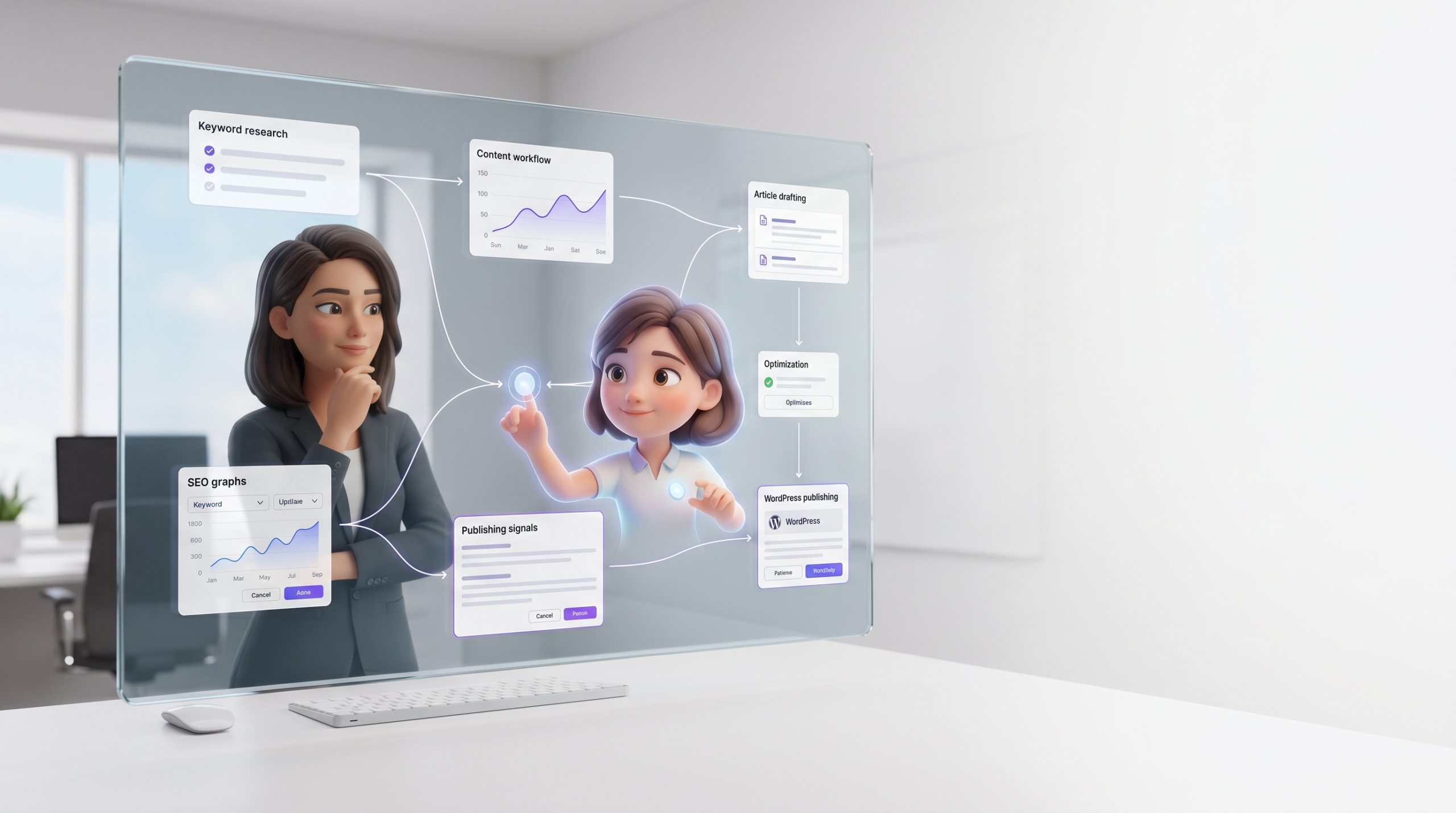
Modern marketing runs on search. An elite agent must have sophisticated SEO capabilities built-in. This goes beyond simple keyword suggestions. It should perform comprehensive topic cluster analysis, identify content gaps, conduct competitor research, and build a content calendar designed to capture organic traffic. Furthermore, it should automatically optimize every piece of content for on-page SEO factors, from meta descriptions to internal linking. This is a core function we explore in our founder’s guide to AI tools for SEO.
This is where autonomy truly shines. After planning the strategy and creating the content, the agent must be able to execute. This means publishing articles to your CMS (like WordPress), scheduling a month’s worth of social media content across platforms, and deploying email drip campaigns to your mailing list. This removes the massive operational bottleneck that plagues lean teams.
It automates opportunity research, content creation, on-page optimization, publishing preparation, and monitoring.
No. It handles repeatable execution so humans can focus on positioning, evidence, and quality control.
A marketing plan is useless if it doesn’t adapt. The best AI marketing agent closes the loop by tracking performance against the initial goals. It should monitor traffic, engagement, conversions, and other KPIs, then use that data to refine its strategy. For example, if a certain blog topic drives significant conversions, the agent might autonomously decide to create more content around that theme. This creates a virtuous cycle of continuous improvement.
With so many new tools on the market, it can be difficult to separate hype from reality. Use this framework to assess whether a solution is a true autonomous agent or just another task-specific tool.
| Evaluation Criterion | Basic AI Tool | True AI Marketing Agent |
| Level of Autonomy | Requires constant human prompting and input for each task. (e.g., “Write me a tweet about X.”) | Operates based on high-level goals and can run for weeks or months without new instructions. (e.g., “Grow my blog traffic.”) |
| Strategic Scope | Single-channel, single-task focus. (e.g., Writes blog posts OR schedules social media.) | Multi-channel and holistic. Develops and executes an integrated strategy across SEO, email, and social. |
| Workflow | Acts as a step in a manual workflow. You are the system integrator. | Manages the entire workflow from research and planning to creation, distribution, and analysis. |
| Data Integration | Operates in a silo. Doesn’t learn from performance data unless you manually feed it back in. | Creates a closed-loop system. Uses performance data from all channels to learn and self-optimize its strategy. |
| Business Value | Saves time on individual tasks. (e.g., writing is 2x faster.) | Drives business outcomes. (e.g., generates qualified leads and automates a core business function.) |
When you’re vetting a potential solution, ask pointed questions. How does it handle strategy? Can it execute a campaign from start to finish without my intervention? How does it measure success and adapt its approach? The answers will quickly reveal whether you’re looking at a simple assistant or a genuine autonomous marketing partner.
Many startups and agencies attempt to build their own ‘agent’ by stitching together multiple AI tools: one for SEO research, another for content writing, a third for social media scheduling, and a fourth for email marketing. This is what we call “tool-chaining,” and it’s a recipe for inefficiency and strategic drift.
The problems with this approach are numerous:
Ordered list
A unified AI marketing agent solves these problems by design. It acts as a single source of truth for all marketing strategy and execution. The SEO strategy directly informs the content calendar, which in turn populates the social media and email campaigns. Performance data from all channels feeds back into one central intelligence core, allowing for true cross-channel optimization. This unified model is not just more efficient; it’s fundamentally more effective.
The evolution of AI in marketing is rapidly moving past simple task automation. The real transformation isn’t about writing a blog post 10% faster; it’s about removing the entire operational layer between strategy and execution. For founders, solo-preneurs, and lean teams, this is a game-changer. It allows you to compete with much larger companies by leveraging an autonomous system that operates with the breadth and consistency of a full marketing department.
This shift allows human talent to focus where it matters most: on high-level brand strategy, customer relationships, and product innovation. Instead of spending hours managing a content calendar or scheduling tweets, you can spend that time talking to customers or planning your next product launch, confident that your marketing engine is running, learning, and optimizing in the background.
At MeetLyra, we are building this future. We believe the best AI marketing agent is one that you can trust to run your growth engine autonomously. It’s a system designed for founders and operators who need to achieve maximum results with limited resources. By unifying strategy, content, and execution, Lyra aims to be the first truly autonomous marketing partner for your business.
Ready to put your marketing on autopilot? Join the private beta waitlist to get early access and see how an autonomous AI marketing agent can transform your growth strategy.
Traditional marketing automation (like HubSpot or Marketo) is primarily rule-based. You set up specific ‘if-this-then-that’ workflows. For example, ‘If a user downloads an ebook, send them this 5-part email sequence.’ An AI marketing agent is strategic and generative. It decides *what* ebook to create in the first place, writes the content, promotes it, and then analyzes the results to decide its next move. It operates on goals, not just pre-programmed rules.
An AI marketing agent replaces tedious operational tasks, not strategic human oversight. It’s designed to augment a lean team, giving a single founder or marketer the leverage of a full department. The human role shifts from ‘doer’ to ‘director.’ You set the brand vision, approve the high-level strategy, and manage the overall business goals, while the agent handles the day-to-day execution of research, content creation, and distribution.
Pricing for AI marketing agents varies, but it’s best viewed as an investment compared to the alternatives. Consider the cost of hiring a freelance writer, an SEO specialist, and a social media manager, or the combined subscription costs of 5-10 different marketing tools. A unified agent is typically priced to be significantly more cost-effective than either of these options, providing the value of a team at the cost of a single software platform.
Small businesses, startups, and solo founders are the ideal users for an AI marketing agent. These businesses typically have the most to gain from automation and leverage. An agent can establish a sophisticated, multi-channel marketing presence that would otherwise be impossible without a dedicated team or a significant budget, leveling the playing field against larger competitors.